

Games Like The Neighborhood Liars
A cozy cul-de-sac. Twelve neighbors. Everybody lies — and the street writes it all down. Bluff any card, slam LIAR! at the right moment and search the garden of whoever got caught, before the impostor buries a bomb in yours. Social deduction for 4-12, with voice, rooms with friends and bots.
Top matches
Match strength key:80+65+50+<50
The Neighborhood Liars
SteamAbout The Neighborhood Liars
Welcome to the friendliest street in the world. Also the most dishonest.
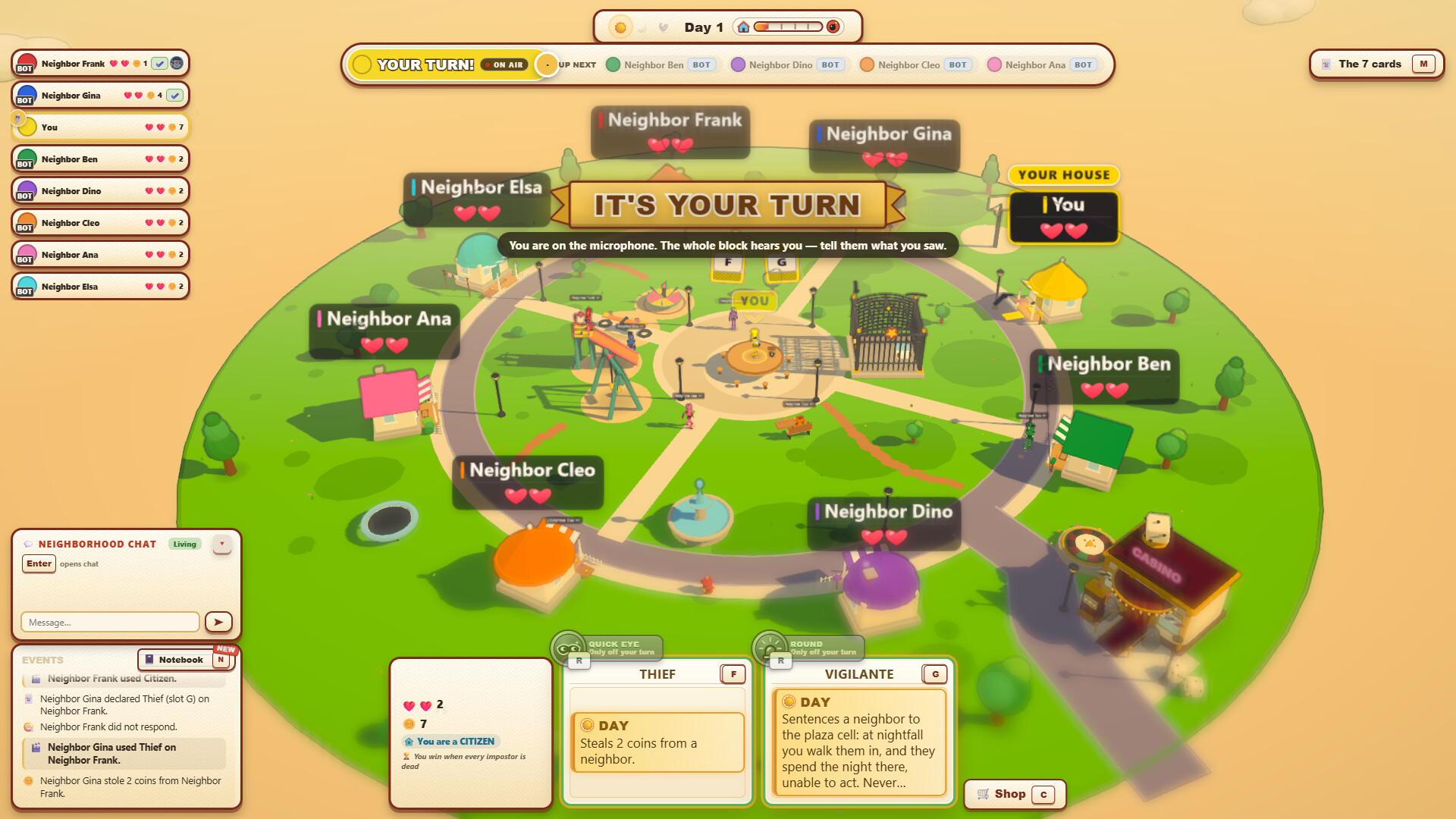
White picket fences. Trimmed lawns. Mailboxes painted to match every house. And somewhere on this cul-de-sac, somebody who spends their nights burying bombs in the neighbors' gardens. The Neighborhood Liars is social deduction and card bluffing for 4 to 12 people. You get two cards, two hearts, and absolutely no obligation to tell the truth. The neighbors are twelve automata: enamelled tin robots with a screen for a face, each with their own head and hat, painted in their player’s color. They walk like wind-up toys, sit on a stool at the plaza table, point at the accused with the whole arm and talk with their screens — the mouth is the wave of your voice. (Prefer the classic beans? They’re in Options.) Every match opens with the whole table watching the neighborhood from the sky together, each neighbor's name lighting up over their house. Then comes a card only you can see: citizen or impostor — and if you're an impostor, who your accomplices are and how many of you sit at the table.
Say anything. Prove nothing.
On your turn your robot walks itself across the street to the plaza table, climbs up and takes the microphone — only then does your 50-second clock start. You play a card face down and declare what it is. That declaration can be a complete lie. If nobody challenges you, the effect happens anyway — invented or not. But if someone slams the LIAR! button within the next few seconds, the two of you draw revolvers in the middle of the plaza:
Everyone sees which of your two cards you spent, never what it was. The whole table can track your hand. That is entirely on purpose.
The night belongs to the impostor
When the sun sets, everyone acts at the same time, in secret — and now the card is real, no bluffing allowed. You visit houses, shield neighbors, watch doorways, poison whoever went out to do harm, swap someone's whole hand in the dark. Except whoever sleeps in the cell: they spend the night behind bars, doing nothing. And the Bomber buries one more bomb. Nobody sees where. Not even the other impostors. If he is the only impostor at the table, he may even stay home — and swear in the morning that it was a quiet night. Come morning the rooster crows, the doors swing open, everyone steps outside together — and that is when you find out whose garden already held two bombs. The house swells, shudders and vanishes in a cartoon mushroom cloud, roof cartwheeling all the way to the plaza.
The doors tell what the night did
In the morning, the report says which doors opened — never where to, never what for. Then every neighbor gives an alibi: "I stayed home", "I went to Ana's", "I went to the casino" — or would rather not say. Swore you stayed home and your door opened? The notebook puts a ⚠ next to your name for the whole table to see. Found the soil in your garden dug up? A bomb went in there — and only you know. And the doormats talk too: every house that had a visitor wakes up with mud at the door — one pair of footprints per person who came. How many, never who. Three swear they went to Ana's and there are only two prints? The math is off, and the notebook marks the house with a ⚠. A print nobody owns up to? Somebody went out and isn't saying. The impostor has an answer up their sleeve: Cover Up hides one door from the Doors of the Night — their own or an accomplice's. The door vanishes from the report. The mud they left on a doormat doesn't.
The street remembers
Everything the table sees ends up in the Neighbourhood Notebook: who played what and on which day, who got caught lying and which card flipped, who slept in the cell, which house went up — and since which night it had been mined, on a crooked little sign stuck in the rubble. Nobody has to memorise twelve neighbors: open the notebook and line the day up against the night. It never writes down a secret. Those are still yours, to tell… or to make up. Call LIAR! and get it right, and you win more than the shot: you cross the street, lean on the fence and search the liar's garden. Bomb or no bomb — only you know. The whole street watched you look. And when a house blows up, nobody pays a thing: the street shuffles out in its pajamas and walks to the round table for the Assembly. Everyone votes for someone or for SKIP — and only a neighbor with more votes than SKIP and than anyone else dies. Sometimes the table fires. Sometimes it just shrugs — and the impostor heard every word.
When talking stops working, call the meeting
Eight coins stop the day cold. Everyone puffs into a little cloud and reappears at the round table in the plaza, under a dramatic sunset. Almost two minutes of open-voice argument, a quick vote — and whoever the table condemns loses EVERY life to a cartoon firing squad. Then their role is revealed. Good luck explaining yourself if you got it wrong.
And at the end, the paper tells all
When the match ends, an extra edition of The Neighbourhood News goes out to everybody, living or dead: who was who, what each neighbor declared and what they really held, day by day and night by night, and the headline of the match. That bluff nobody caught? It's in print. With your name on it.
Seven cards, day and night — and a lot more in Advanced
Every card does one thing by day and something completely different at night. The card you burn bluffing in daylight is the one you cannot use for real after dark. In Advanced each one also has a STREET trick — some you trigger, some fire by themselves — and card answers card: every day play but the Citizen's can be RESPONDED to by one specific card. Two triangles to draw in your head, not a table to memorise.
Classic or Advanced
Classic is the whole game without the street and the responses: the cards with their day and night, the bluff, the search, the notebook, the assembly and the paper, and nothing else. It is the way in. After five finished matches, Advanced opens up: the Spy, the street tricks and the responses. The host picks in the lobby — and the whole table plays what the host picked.
Your room, your street
Create a room and choose who gets in: Steam friends (they join from an invite or their friends list) or Code only (listed nowhere — only whoever has the code walks in). Everyone else picks Join with a code or accepts the Steam invite. No Steam? The room is hosted on your PC, and anyone on the same network joins with your IP and the code. There are no strangers here: every table is people you brought. The studio's community lives on Discord , one click away on the title screen and in the menu.
Neighbors who think
The bots do not cheat: each one decides only from what its own seat can see — just like you. They remember what you swore, accuse with a reason, vote on suspicion, bluff at the rate of their role and drop a line in the chat now and then. Any of them might be the impostor. Want bots at your table? In your room, +1 bot seats one more neighbor and the × sends one home. A room with just you and the bots is a whole match — and hosted on this PC, it does not even need the internet.
Voice over Steam, the way a street talks
At a Classic table, the voice belongs to everyone: by day every living neighbor hears every other, from any corner of the street. In Advanced, the day’s voice is proximity: full next to your robot, fading with distance — walking off in pairs is whispering — and whoever is at the table speaks into the microphone to the whole street. At the meeting and the assembly, everyone hears everyone. At night, silence — except on the impostors’ line: with two or more alive, they plot among themselves, by voice and chat, and the city hears nothing. Voice travels over Steam's network through the host, who hands each line only to those allowed to hear it — nobody receives anybody's address. Your mic starts open. A microphone icon on screen always shows whether you are being heard, and Options lets you switch to push-to-talk, test and calibrate your mic and set each neighbor’s volume.
There is something to do out there
Twelve toys scattered down the street — a playground, a trampoline, a fire hydrant, a fallen bicycle — and a neon-lit casino on the corner, with a roulette wheel, a one-armed bandit and dice out on the pavement.
What's in the box
One last thing
You will lie to your friends. They will lie to you. Somebody is going to blow up their own house by mistake — and the paper will put it on the front page. That's the game.
Steam data © 2026 Valve Corporation. Trademarks are property of their respective owners.
All matches
Similar games to The Neighborhood Liars
Finding similar games…