
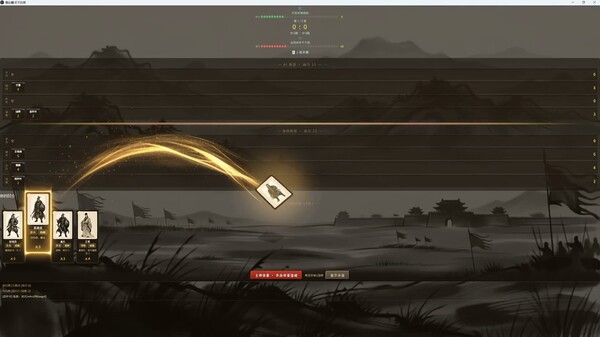


Strategy card game set in China's Northern and Southern Dynasties. Command nine historical rulers and 120 general, minister and stratagem cards across four battle lines - infantry, cavalry, navy and strategy - each scored alone. Every card costs provisions, and your hand carries over between rounds.
Top matches
Match strength key:80+65+50+<50
Nan-Bei Chao: War of Dynasties
SteamAbout Nan-Bei Chao: War of Dynasties
One game of North vs. South, half a history of China.
About the Game
From 420 to 589 AD, China split into Northern and Southern Dynasties — the South cycling through Song, Qi, Liang and Chen, the North through Northern Wei, Eastern Wei, Western Wei, Northern Qi and Northern Zhou. Nine legendary rulers contend for the Central Plain across 120 cards drawn from the annals: generals, ministers, poets, formations, monks, crafts, items and stratagems.Nan-Bei Chao: War of Dynastiesis a strategy card game built on that turbulent era, turning historical figures, legendary campaigns and military doctrine into matches anyone can pick up. Every ruler carries a distinct faction identity (Song · Purple, Qi · Cyan, Liang · Gold, Chen · Green against Northern Wei · Red, Eastern Wei · Blue, Western Wei · Grey, Northern Qi · Orange, Northern Zhou · Dark Gold), and every general has his own ink-wash portrait — all card art is AI-assisted ink-brush warrior illustration, built on ochre, gamboge and ink black with faction-colored highlights.
Core Gameplay
Four Battle Lines
The battlefield splits into four rows, each scored independently:
Each row resolves on its own: higher row power takes the row.
Taking more rows wins the round; on an even split,total round powerbreaks the tie.
Eight Card Types
Provisions: Your Play Budget
Provisions are the core resource —every card costs provisions to play.
Running out of cards isn't a loss, but an empty treasury forces you to discard and pass —resource management is the real tension of every round.
Hands Carry Over
The single most important rule:the board resets each round, but your hand does not.
So the real wager isn't "who's stronger in this row" — it's"which cards do I still have to survive three rounds". Your opponent sees the you who brought old cards into round two. Holding cards, hoarding provisions, managing the cap — all of it is strategy.
Mulligan
Only the first rounddeals 10 cards and offers a mulligan —discard up to 3 cardsand draw the same number back. Rounds two and three have no mulligan phase, only new cards.
Traps: The Hidden Edge
Trap cardshide in your hand and can be buried into any row:
The rule is strict:only the player who buried them can see how many traps exist— the opponent gets no warning at all. When one triggers, the victim gets an on-screen alert. The entire mind game lives in that asymmetry.
Commands and Command Points
Each player has1 command point per roundto playcommand cards(Redeploy, Change Guard, Clear the Road…). Commands occupy no row — they're tactical resources off the battlefield.
Weather
Each round draws aweather card(Snow · River · Heat · Fog · Drought · Clear) that alters the round's rules rather than adding raw power: row power modifiers, higher card costs in a row, changes to the hand limit, changes to provision income, andhiding a row's information(Fog). Some cards can dispel weather, at a cost in provisions.
Secret Decrees: A Shared Objective
Every deck carries2 secret decrees(such as "Jiangnan" or "Northern Expedition"). They aren't played —both sides accumulate progress toward them together, and completing one grants a bonus. So beyond the contest, there's a shared destination.
Counters
Many generals carrycounter skills(row suppression, faction matchups, linked counters), and there's an active counter card,Clear the Road. Information and prediction are the game's second layer of depth.
Leader Passives
Each of the nine rulers has a signature passive:
AI Opponent
Randomized rulers: each AI match draws a random rival, keeping replays fresh. The AI farms provisions, holds cards, passes when it can't afford to play — it counts cards and reads your mulligan.
Visual & Audio Style
An ink-wash historical aesthetic.
Three Game Modes
Every mode isbest of three(first to two wins). Each round shows arow-by-row score, and theboard resets while hands carry over— so rounds two and three are played with an ever-thicker hand.
Match Flow
Round 1: Pick ruler → Mulligan (up to 3) → Play cards (spend provisions) → Row-by-row score Round 2: +6 cards (hand carries over) → Play cards (spend provisions) → Row-by-row score Round 3: +6 cards (hand carries over) → Play cards (spend provisions) → Row-by-row score ↓ Best of three (first to two wins)
System Requirements
Minimum: Windows 10 (64-bit), dual-core 1.6 GHz, 4 GB RAM, Intel HD 4000 or equivalent, 500 MB disk space, 1280×720 Recommended: Windows 10/11 (64-bit), quad-core 2.0 GHz or higher, 8 GB RAM, discrete GPU, 1 GB disk space, 1920×1080Single-player and hot-seat are fully offline. No in-app purchases, no ads, no tracking.Multiplayer relays through Steam P2P and requires no networking service beyond your account.
Achievements
16 Steam achievements:
About the Developer
Independent developer. Launching on Steam, Windows desktop only (Electron 28).
Steam data © 2026 Valve Corporation. Trademarks are property of their respective owners.
All matches
Similar games to Nan-Bei Chao: War of Dynasties
Finding similar games…